
Facial Rejuvenation
Midface Lift
중안면거상술A targeted lift for the center of the face, from the under-eye area to the nasolabial folds, performed through a small incision hidden beneath the lower lashes.

The midface lift
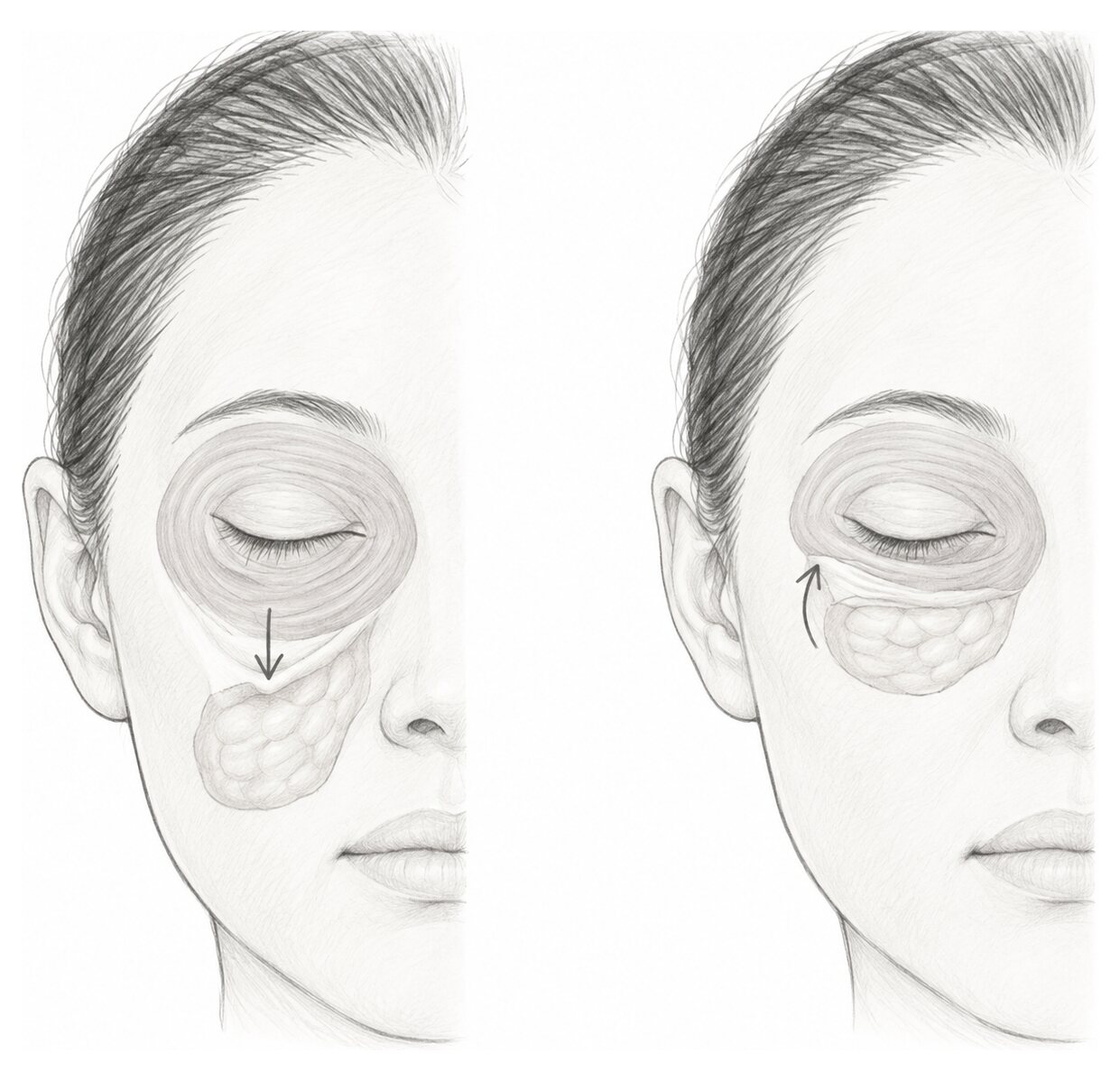
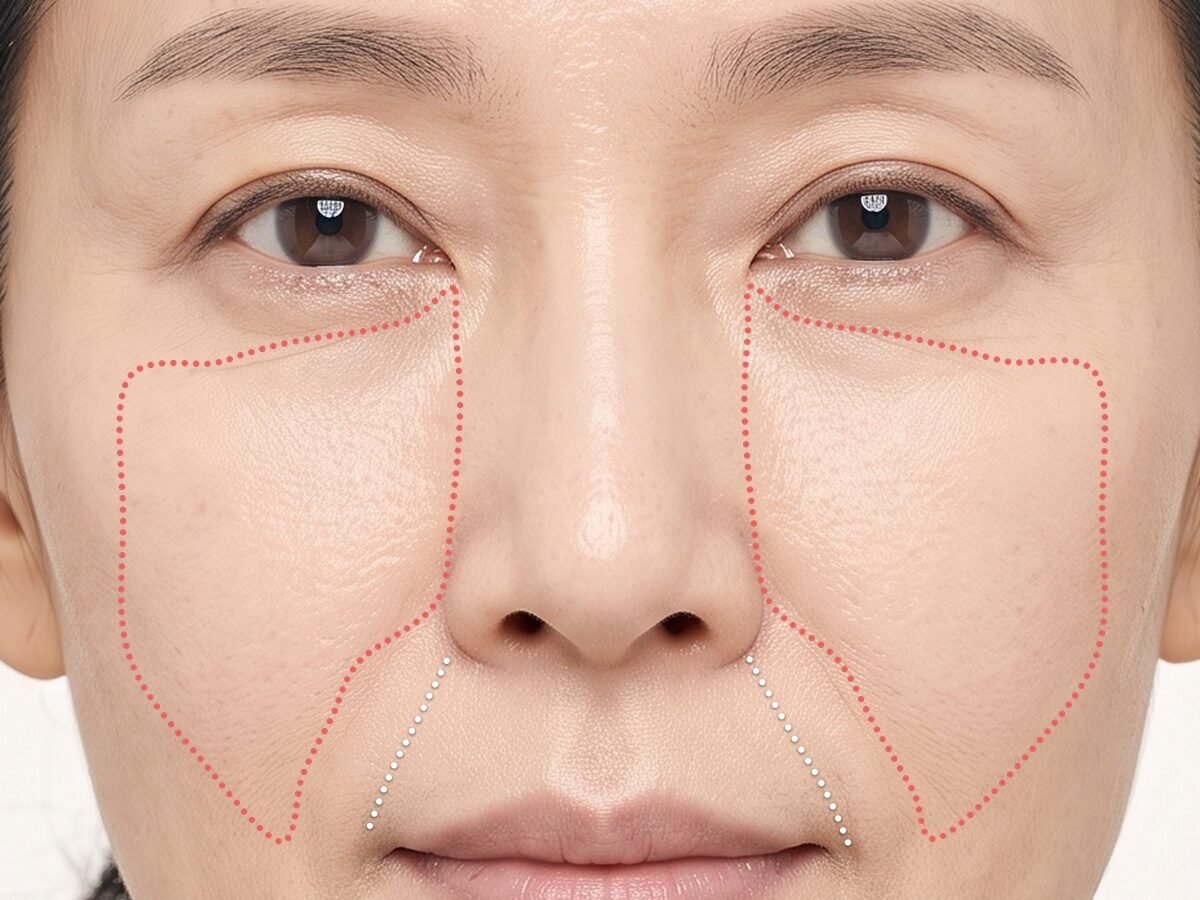
The midface lift repositions the tissues of the central face: the area beneath the eyes, the front of the cheeks and the nasolabial folds. It is a lift of precisely this zone, which descends earlier and more visibly than many people expect.
Through a short incision and careful lifting, visible scarring is kept to a minimum and the face regains a clear, rested appearance. The procedure applies across a wide age range, from people in their twenties troubled by early nasolabial folds to those in middle age and beyond who notice cheek descent.
Restore structure while preserving natural expression: the midface lift returns the volume of the cheek to where it came from, rather than adding to it.
Who this procedure is for
- 01
Descent from the under-eye area to the cheek
The tissue from beneath the eyes to the front of the cheek has dropped noticeably, leaving the midface flat and heavy.
- 02
Bulging under-eye fat
Fat beneath the eyes protrudes and the border between lid and cheek has become a step.
- 03
Deep tear troughs or dark circles
A hollow runs from the inner corner of the eye across the cheek, casting a shadow that makes the eyes look tired.
- 04
Lid change after lower blepharoplasty
The lower eyelid has been pulled down or rounded after a previous lower eyelid operation, and support from the midface is needed to correct it.
- 05
Nasolabial folds that age the face
Sagging along the folds beside the nose has become pronounced enough to change the expression at rest.
Lower blepharoplasty vs. midface lift
Lower blepharoplasty treats the under-eye area only; the midface lift treats the under-eye area, the cheek and the folds together.
| Lower blepharoplasty | Midface lift | |
|---|---|---|
| Main purpose | Removing under-eye fat and tidying loose skin | Restoring volume and lifting the midface (cheekbone area and nasolabial folds) |
| Area treated | Centered on the lower eyelid | A wider zone, from under the eyes to the nasolabial folds |
| Operating time | About 1 to 2 hours (relatively simple) | About 2 to 3 hours (relatively complex) |
| Recovery period | About 1 to 2 weeks | About 2 to 3 weeks |
| Possible side effects | Dry eye; possible ectropion (outward turning of the lid) | Temporary numbness |
Advantages of the midface lift
Selective lifting. Only the midface is lifted, so recovery is faster than after a full facelift and the return to daily life is easier.
Two concerns, one procedure. Lifting the central face in three dimensions improves the nasolabial folds and the under-eye descent at the same time.
Limited dissection. The incision is small and tissue disturbance is limited, which makes the procedure a reasonable option for patients over 50 as well as for younger ones.
A concealed scar. The fine incision beneath the lower lashes keeps the scar out of sight and heals naturally.

Why the midface descends
Planning starts from tissue structure: what has deflated, what has descended and what the bone contributes.
The midface is where the effects of aging in each layer converge. The cheek fat, held high over the cheekbone in youth, deflates and slides downward and inward. As it goes, the under-eye area hollows, the tear trough deepens and the fold beside the nose becomes more pronounced.
Beneath the fat, the fascial layer loosens and the ligaments that anchor the cheek to the bone stretch. The rim of the eye socket and the cheekbone also lose a little projection with age, so there is less scaffold to support the soft tissue.
This is why filling the tear trough or removing under-eye fat alone can disappoint in a face where the cheek has descended. The tissue is not missing; it has moved. The midface lift returns it to the position the bone can support.
Your doctor begins every plan with this distinction. It decides how much lifting, how much fat repositioning and how much restraint each face needs.

The procedure, step by step
- STEP 01
Assessment
Before surgery, the folds, the descent of the cheek and the under-eye area are examined precisely and the extent of the lift is marked.
- STEP 02
A fine incision and careful dissection
A small incision is made along the line beneath the lower lashes, and the tissues are released in detail while the structures around the eye are protected.
- STEP 03
Lifting and fixation
The fascial layer and soft tissue of the midface are lifted upward and fixed in their new position, so that the support is carried by the deeper layer.
- STEP 04
Fat management and closure
Excess fat is removed or repositioned where it is needed, and the incision is closed with fine sutures.
What makes our midface lift different
- SPECIAL 01

Led by our physicians
Consultations and procedures are led by Dr. Jeong or Dr. Lee, supported by our medical team. Read more about our doctors.
- SPECIAL 02
Systematic analysis, safety-first design
The range of lifting is analyzed for each patient's facial structure, so that unnecessary tissue disturbance is avoided and the outcome is predictable.
- SPECIAL 03

Three-dimensional midface lifting
The SMAS and fascial tissues are elevated with anatomical precision, improving the nasolabial folds, the front of the cheek and the under-eye area in a single procedure.
- SPECIAL 04

Safety-centered care through recovery
From pain management in the early recovery phase to attentive aftercare, the burden of side effects is reduced and comfort comes first.
Consultation, surgery and recovery: what to expect
- STAGE 1
Consultation
Your doctor examines the under-eye area, the position of the cheek fat and the depth of the folds, and discusses whether a midface lift, lower blepharoplasty, under-eye fat repositioning or a combination is the appropriate operation. Some patients are surprised to learn that their under-eye concern is a cheek concern.
- STAGE 2
Surgery
The midface lift takes about 2 to 3 hours. It is a more involved procedure than a lower blepharoplasty, because the deeper layers are released and fixed rather than the skin and fat alone.
- STAGE 3
Recovery
Swelling and bruising around the eyes and cheeks are expected and settle gradually; the recovery period is usually about 2 to 3 weeks. Temporary numbness of the cheek can occur and typically improves with time. Follow-up visits check healing and the position of the lower lid.
- STAGE 4
The settled result
The contour refines as the swelling resolves. Results vary from person to person, and aging continues afterward; the aim is a durable reset of the midface rather than an end to change.
Frequently asked questions
- Q1
How is a midface lift different from lower blepharoplasty?
Lower blepharoplasty addresses the under-eye area: fat and loose skin. The midface lift addresses the descent of the cheek that often causes the under-eye hollow in the first place, together with the nasolabial fold. The comparison table above sets out the differences in scope, operating time and recovery.
- Q2
Will there be a visible scar?
The incision is a fine line beneath the lower lashes, following the natural line of the eyelid. It generally heals to a mark that is difficult to see, though healing varies from person to person.
- Q3
Could it change the shape of my eye?
Any operation near the lower lid carries some risk of altering its position. The midface lift supports the lower lid from below rather than pulling on it, which is why it is also used to correct lid change after previous lower eyelid surgery. Dr. Jeong assesses lid tone before surgery and plans accordingly.
- Q4
Is it suitable for someone in their twenties?
It can be, where early nasolabial folds or under-eye hollowing are caused by cheek descent rather than by volume loss alone. The consultation determines which; sometimes a smaller procedure is the right answer.
- Q5
Can it be combined with a facelift?
Yes. Where the lower face and neck have changed as well, a midface lift may be planned together with a facelift or a neck and double chin lift. Where only the center of the face has changed, it stands alone.
Begin with
a conversation.
Consultations are led by Dr. Jeong or Dr. Lee, with our medical team supporting you throughout your visit. Appointments are recommended so that you can be seen without waiting, in English or Korean.
Results and recovery times vary from person to person, and every medical procedure carries potential side effects. The information on this page is provided for general guidance only and does not replace an in-person consultation. Please consult with our doctors for advice specific to your case.